Utila Mesoamerican Reef Wall
Utila Wall, Bay Islands, Honduras · Latin America & Reefs · ocean_reef
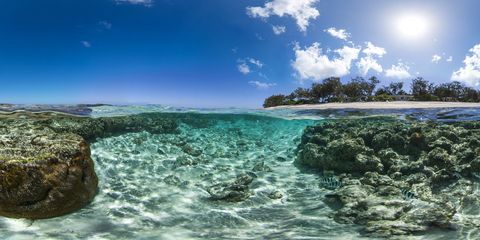
About this place
Examine Mesoamerican Barrier Reef coral holobionts, Acanthurus herbivore grazing guilds, and Elacatinus cleaning symbioses.
For kids: Float along a sunlit Caribbean coral wall where blue tang schools mow seaweed lawns and tiny gobies run fish car-washes!
Utila Mesoamerican Reef Wall · 360° Habitat Camp
What to look for
- Boulder star coral holobiont — Orbicella annularis — Symbiodiniaceae. Centre the primary framework-building Orbicella colonies along the wall crest
- Blue tang grazing highway — Acanthurus coeruleus herbivore guild. Locate the carbonate spur patrolled by roving Acanthurus grazing schools
- Brain coral goby car-wash — Elacatinus evelynae cleaning station. Scan the grooved Pseudodiploria head hosting sharknose goby cleaners
Source: Rohwer et al. (2002), Coral Reefs & Mumby (2006), Science — Multipartite coral holobionts and Caribbean herbivore phase-shift resilience.
Ask together: What happens to tiny flower seedlings in a garden if nobody ever trims tall fast-growing weeds—and how is a coral reef the same?
Field quiz
Kids' question: How do schools of bright blue tang fish help baby corals grow along the reef wall?
- They mow down fast-growing seaweed so baby corals get room and sunlight
- They stack heavy rocks with their tails
- They blow warm air bubbles from the surface
Answer
They mow down fast-growing seaweed so baby corals get room and sunlight
Adults' question: What ecological cascade follows intense grazing by Caribbean parrotfish and surgeonfish guilds (Mumby, 2006)?
- Suppression of macroalgal turf doubles coral larval recruitment onto bare coralline limestone
- Complete elimination of Symbiodiniaceae from polyp tissues
- Acidification of lagoonal aragonite saturation states
- Conversion of stony reefs into deep aphotic sponge gardens
Answer
Suppression of macroalgal turf doubles coral larval recruitment onto bare coralline limestone
360° photo: © Underwater Earth / XL Catlin Seaview Survey / Aaron Sp, CC BY-SA 3.0
See it live: Live check: Top of the Reef Wall Cam
- By day
- Blue tang schools, stoplight parrotfish, yellowtail snappers & bar jacks Observe diurnal herbivore grazing pulses sweeping across the live Western Caribbean shelf-edge spur.
- By night
- Tentacle-extended coral polyps, basket stars & foraging squirrelfish After dusk, parrotfish secrete protective mucus cocoons in crevices while scleractinian polyps extend nematocyst-armed tentacles to feed.
Other language: Русский