Taiaroa Head Royal Albatrosses
Pukekura / Taiaroa Head, Otago Peninsula, South Island, New Zealand · Oceania · wetland_coast
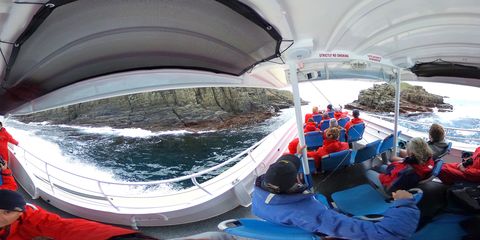
About this place
Analyze Diomedea sanfordi shoulder-lock biomechanics, Rayleigh-cycle dynamic soaring, and Earth's only mainland albatross colony.
For kids: Stand on a windy New Zealand cliff where giant ocean gliders lock three-metre wings open and circle the whole planet without flapping!
Taiaroa Head Royal Albatrosses · 360° Habitat Camp
What to look for
- Tussock nest mound ('toroa' nursery) — Diomedea sanfordi biennial breeding. Centre the silver-tussock slope hosting volcanic-soil nest pedestals
- Roaring-Forties launch bluff — Shoulder-lock tendon & runway lift. Locate the windward headland lip providing high-lift takeoff airflow
- Southern Ocean dynamic-soaring waves — Boundary-layer wind-gradient extraction. Scan the open Southern Ocean horizon where boundary-layer wind shear powers flight
Source: Sachs et al. (2012), PLOS ONE & Meyers & Stakebake (2005), Journal of Morphology — Dynamic soaring S-trajectories & procellariiform shoulder-lock anatomy.
Ask together: Hold both your arms straight out to the sides for sixty seconds—feel your shoulders tire, and imagine how handy an albatross's 'wing-latch' tendon is!
Field quiz
Kids' question: How can a royal albatross glide thousands of miles across windy oceans without getting sore wing muscles?
- A built-in shoulder tendon latch locks its wings open while it surfs fast and slow wind layers
- Friendly dolphins push it from underneath
- It lands on passing ships every ten minutes
Answer
A built-in shoulder tendon latch locks its wings open while it surfs fast and slow wind layers
Adults' question: Where does the kinetic energy come from that allows Diomedea albatrosses to fly upwind and crosswind for days without flapping (Sachs et al., 2012)?
- Vertical wind-speed shear in the lowest 15–20 m above ocean waves harvested via cyclic S-turns
- Hot volcanic thermals erupting continuously from abyssal trenches
- Solar-heated air sacs inflating inside hollow wing quills
- Electrostatic repulsion from salty ocean spray
Answer
Vertical wind-speed shear in the lowest 15–20 m above ocean waves harvested via cyclic S-turns
360° photo: Tasmanian Gov. Education, CC BY 2.0
See it live: Live check: DOC Royal Cam — Northern Royal Albatross Chick
- By day
- Fluffy white royal albatross chick ('toroa'), returning parents & soaring adolescent sky-gamms Notice tubular external nostrils ('tubenoses') along the upper bill—housing salt-excreting glands and olfactory sensors for locating squid patches.
- By night
- Down-insulated albatross chick resting safely in tussock grass under Otago wind Once past the six-week guard stage, chicks thermoregulate solo in gale-force tussock microhabitats while both parents forage across the Tasman Sea.
Other language: Русский