Stony Point Tuxedo Penguins
Stony Point, Betty's Bay, Western Cape, South Africa · Africa · wetland_coast
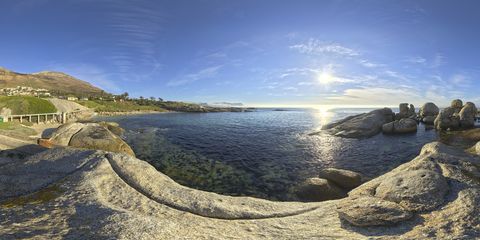
About this place
Study Spheniscus demersus supraorbital vasodilation thermoregulation and pelagic countershading on the Cape coast.
For kids: Meet warm-weather penguins in sunny South Africa who cool down using rosy pink windows right above their eyes!
Stony Point Tuxedo Penguins · 360° Habitat Camp
What to look for
- Sunlit granite penguin boulders — Supraorbital thermal window & spot ID. Centre the granite haul-out boulders where penguins regulate heat load
- Cold kelp-forest surf zone — Ecklonia maxima & Thayer countershading. Locate the cold inshore kelp surf where penguins commute to pelagic baitballs
- Dassie & cormorant rock ledges — Shared coastal seabird & Procavia colony. Scan the upper coastal ledges shared with endangered Crowned and Bank cormorants
Source: Frost, Siegfried & Greenwood (1976), Journal of Zoology — Behavioral & vascular thermoregulation in the African penguin (Spheniscus demersus).
Ask together: How does wearing a black back AND a white belly at the same time help a swimming penguin hide from above and below?
Field quiz
Kids' question: Why do the bare patches above an African penguin's eyes turn bright rosy pink on a sunny day?
- Warm blood flows there to let extra heat escape into the sea breeze
- Because they eat pink cotton candy
- To signal airplanes flying overhead
Answer
Warm blood flows there to let extra heat escape into the sea breeze
Adults' question: How does Spheniscus demersus prevent hyperthermia while incubating eggs ashore despite dense cold-water insulation?
- Vasodilation in unfeathered supraorbital glands coupled with shaded burrow nesting
- Shedding all waterproof contour feathers every afternoon
- Sweating salt water from giant glands on their webbed feet
- Panting underwater while holding their breath
Answer
Vasodilation in unfeathered supraorbital glands coupled with shaded burrow nesting
360° photo: Greg Zaal (Panorama) Rico Cilliers (Backplates), CC0
See it live: Live check: Stony Point African Penguin Colony Cam
- By day
- African penguins preening & commuting, Cape cormorants, kelp gulls & rock dassies Uropygial preen-gland lipids maintain interlocking feather barbules so cold seawater never contacts the penguin's warm skin.
- By night
- Penguins returning from sea at dusk & braying courtship calls from burrows Crepuscular landing waves minimize gull kleptoparasitism while ecstatic donkey-like braying reunites mated pairs across crowded burrows.
Other language: Русский