South Georgia King Penguins
St Andrews Bay, South Georgia (54.4°S) · Antarctica · polar
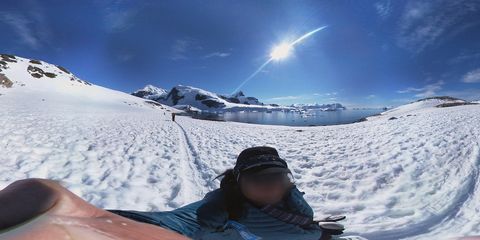
About this place
Examine Aptenodytes patagonicus two-voice syrinx cocktail-party recognition, brood-pouch incubation, and Polar Front foraging.
For kids: Hear how parent king penguins find their one fluffy brown chick inside a crowd of three hundred thousand birds!
South Georgia King Penguins · 360° Habitat Camp
What to look for
- Glacial outwash colony plain — Aptenodytes patagonicus crèche zone. Centre the outwash plain where nestless king penguins space by flipper-reach
- Elephant-seal & lanternfish surf — Antarctic Polar Front commute. Locate the beach surf zone launching 300 m dives toward the Polar Front
- Allardyce Range barrier glaciers — Katabatic wind shelter. Scan the 2,900 m mountain spine sheltering northeast South Georgia
Source: Aubin & Jouventin (1998), Proc. R. Soc. B — 'Cocktail-party effect' acoustic recognition in king penguin colonies.
Ask together: How could you find your family in a giant stadium without phones, signs, or waving hands—using only a special sound?
Field quiz
Kids' question: How does a returning king penguin find its own chick among thousands of noisy neighbors?
- A unique two-note trumpet call that works like a secret voice password!
- Reading numbers on flippers
- Following footprints in wet sand
Answer
A unique two-note trumpet call that works like a secret voice password!
Adults' question: How long does it take a single king penguin pair to fledge one chick through a subantarctic winter?
- 14 to 16 months—including overwinter chick fasting in downy crèches
- Just 28 days in midsummer
- Exactly 5 years underground
- Two weeks before autumn freeze-up
Answer
14 to 16 months—including overwinter chick fasting in downy crèches
360° photo: eneerhut, CC BY-SA 4.0
See it live: Live check: Subantarctic Penguin Colony
- By day
- Subantarctic penguins trumpeting, bowing & guarding coastal nest territories Observe ecstatic sky-pointing displays and mutual allopreening reinforcing pair bonds between ocean foraging shifts.
- By night
- Subantarctic wind, ocean surf & huddled colony silhouettes Social thermoregulation in dense crèches minimizes surface-to-volume heat loss during subantarctic squalls.
Other language: Русский