Sonoran Saguaro Cactus Hotel
Saguaro National Park, Tucson, Arizona, USA · North America · desert_night
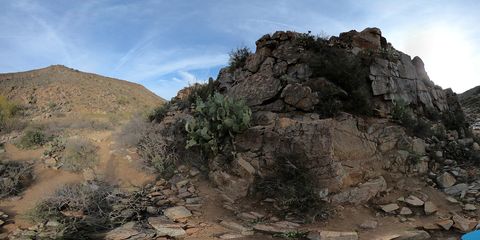
About this place
Analyze Carnegiea gigantea pleated rib hydration, Gila woodpecker saguaro boots, and glossophagine bat pollination.
For kids: Explore giant accordion-ribbed cacti that stretch wide after desert rain and host tiny elf owls inside cool rooms!
Sonoran Saguaro Cactus Hotel · 360° Habitat Camp
What to look for
- Accordion water-tank ribs & boot hole — Pleated parenchyma & callus 'saguaro boot'. Centre the fluted saguaro stem and healed Gila woodpecker nest cavity
- Night-blooming nectar crown — Leptonycteris yerbabuenae chiropterophily. Scan the upper arm tips where nocturnal flowers recruit lesser long-nosed bats
- Green-bark palo verde nurse tree — Parkinsonia microphylla seedling nurse. Locate the photosynthetic-barked palo verde nurse tree shading saguaro recruits
Source: Fleming et al. (2001), Ecological Monographs; Nobel (1988) — Carnegiea gigantea biophysics, CAM water storage & bat mutualism.
Ask together: Why do giant saguaro flowers wait until cool night darkness to pop open instead of blooming in blazing daytime sun?
Field quiz
Kids' question: How do the pleats on a giant saguaro cactus work right after a summer desert rainstorm?
- They stretch wide like an accordion to store tonnes of rainwater inside!
- They play musical desert tunes in the wind
- They flap like wings to fan lizards
Answer
They stretch wide like an accordion to store tonnes of rainwater inside!
Adults' question: How does Crassulacean Acid Metabolism (CAM) allow Carnegiea gigantea to photosynthesize with minimal desert water loss?
- Opening stomata exclusively at cool night hours to fix CO2 as malic acid before daytime Calvin-cycle processing
- Pumping groundwater from three hundred metres deep with taproots
- Shedding succulent outer skin after every thunderstorm
- Absorbing carbon exclusively through root hairs
Answer
Opening stomata exclusively at cool night hours to fix CO2 as malic acid before daytime Calvin-cycle processing
360° photo: BLMArizona, Public domain
See it live: Live check: Southwest Sunlit Rock & Sanctuary Cam
- By day
- Sanctuary wolves basking on warm boulders, magpies, & arid scrub Across arid Southwestern landscapes, microclimate selection—boulder shade and burrow refugia—cuts daytime evaporative cooling demands.
- By night
- Crisp high-desert starlight, twilight howls, & cooling canyon breezes Low atmospheric water vapour allows rapid nocturnal longwave radiative cooling, awakening desert mammals, owls, and pollinators.
Other language: Русский