Caledonian Pine & Loch Ospreys
Loch Garten, Abernethy Forest, Highlands, Scotland · Europe · temperate_forest
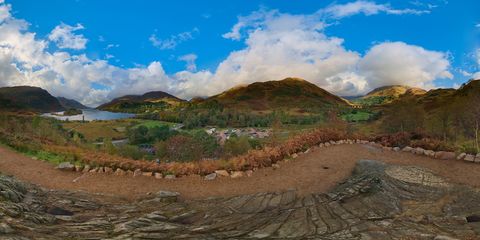
About this place
Examine Pandion haliaetus reversible zygodactyly, plantar spicules, and trans-Saharan migration to Highland lochs.
For kids: Visit ancient Scottish pine woods where fish-hunting ospreys rotate their outer toes and turn slippery trout nose-first!
Caledonian Pine & Loch Ospreys · 360° Habitat Camp
What to look for
- Flat-topped 'Granny' Scots pine — Pinus sylvestris osprey eyrie crown. Locate the open-grown Caledonian Pinus sylvestris crown suited for osprey eyries
- Peat-stained Highland trout loch — Pandion haliaetus plunge-dive zone. Centre the clear wind-rippled loch surface patrolled by plunging ospreys
- Heather & blaeberry pinewood floor — Tetrao urogallus understory guild. Scan the Vaccinium-Calluna understory supporting capercaillie and endemic Scottish crossbills
Source: Poole (1989) & Sustaita et al. (2013), Journal of Experimental Biology — Pandion haliaetus reversible zygodactyl grip mechanics and trans-Saharan satellite telemetry.
Ask together: Why does an osprey always turn a caught fish so the fish's head points straight forward while flying back to the nest?
Field quiz
Kids' question: How do an osprey's special toes help it hang onto a super-slippery fish?
- One outer toe flips backward so two toes grip each side over spiky foot pads
- Webbed duck paddles glue the fish to its belly
- Tiny suction cups like an octopus tentacle
Answer
One outer toe flips backward so two toes grip each side over spiky foot pads
Adults' question: Which combined anatomical specializations distinguish Pandion haliaetus among diurnal raptors?
- Reversible outer fourth toe, keratinous plantar spicules, and sealable nasal valves
- Echolocation clicks paired with serrated tooth-like tomia
- Hollow buoyant leg bones filled with warm helium
- Complete loss of preen gland oils to sink deeper
Answer
Reversible outer fourth toe, keratinous plantar spicules, and sealable nasal valves
360° photo: Daniel Kraft, CC BY-SA 3.0
See it live: Live check: Highland Caledonian Pine Osprey Eyrie
- By day
- Ospreys delivering trout & pike, crested tits, red squirrels & crossbills GPS-tracked Highland ospreys cross the Bay of Biscay and Sahara solo, wintering in Senegambian mangrove lagoons over five thousand kilometres south.
- By night
- Brooding ospreys atop ancient pine & long northern Scottish summer twilight At fifty-seven degrees north, brief summer nights extend diurnal foraging windows needed to raise fast-growing osprey broods.
Other language: Русский