Savanna 360° Camp
Chyulu Hills & Amboseli, Kenya · Africa · savanna
About this place
Chyulu Hills & Amboseli waterhole from 06:08 sunrise to 18:19 sunset.
Sunrise Watch: First Light at the Pan
Chyulu Hills waterhole hide, 06:08 EAT sunrise watch.
What to look for
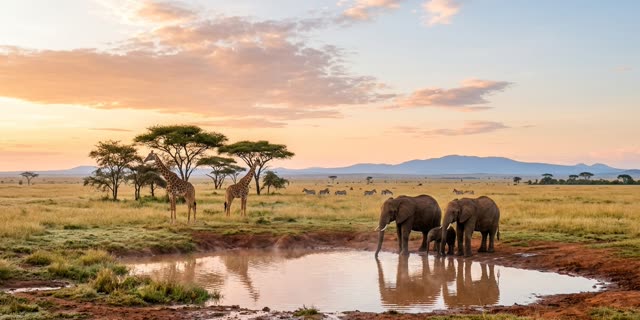
- African bush elephant family — Loxodonta africana. Log the Loxodonta africana matriarch, allomother & calf at the bank
- Maasai giraffes at first light — Giraffa tippelskirchi. Log the two Maasai giraffes (Giraffa tippelskirchi) along the acacia line
- Equatorial sunrise (06:08 EAT) — Partly cloudy dawn · ~17°C. Log the eastern sunrise glow & partly-cloudy dawn cumulus layer
- Dawn waterhole mist — Radiative night cooling over warm pan water. Log the thermal evaporation mist across the waterhole surface
Source: McComb et al. (2001), Science & Moss (1988) — Matriarchal leadership and anti-predator calf-flanking in Loxodonta africana.
Ask together: Notice where the tiny elephant calf walks! Who in your family walks on the outside when you cross a busy street together?
Field quiz
Kids' question: Why does the baby elephant walk tucked right between its mom and auntie?
- To stay out of the mud
- So the big adults shield it from lions and hyenas
- Because baby elephants cannot swim
Answer
So the big adults shield it from lions and hyenas
Adults' question: What drives tight calf-flanking as an elephant family approaches a dawn waterhole?
- Dominance competition over mineral mud
- Anti-predator perimeter defense while crepuscular carnivores are still active
- Thermoregulation against morning mist
- Preventing cattle egrets from landing on calves
Answer
Anti-predator perimeter defense while crepuscular carnivores are still active
Savanna Breeze: Mud Baths & Canopy Browsers
Mid-morning watch (~24°C, partly cloudy fair-weather cumulus, 17 km/h ESE breeze).
What to look for
- Elephant mud & water shower — Evaporative cooling & UV barrier. Log the trunk-spraying thermoregulation behaviour in the pan
- Cattle egrets — Bubulcus ibis. Log the commensal cattle egrets (Bubulcus ibis) on the shoreline
- Umbrella thorn browsing — Vachellia tortilis · upper-canopy guild. Log canopy-stratified giraffe browsing on Vachellia tortilis
- Plains zebras — Equus quagga. Log the peripheral Plains zebra herd (Equus quagga)
Source: Lillywhite & Stein (1987) & Martins et al. (2018), Nature Communications — Elephant skin micro-channel water retention and savanna browser niche partitioning.
Ask together: If giraffes eat top leaves, zebras munch low grass, and egrets catch bugs, how is a savanna waterhole like a polite family dinner table?
Field quiz
Kids' question: Why do cattle egrets walk right beside elephants and zebras?
- They ask the elephants for water
- Big footsteps scare up insects for the birds to eat
- They are guarding the waterhole
Answer
Big footsteps scare up insects for the birds to eat
Adults' question: How does the elephant–giraffe–zebra–egret waterhole assemblage reduce competition and risk?
- All four species eat identical short grass
- Vertical feeding stratification plus shared multi-sensory predator vigilance
- Egrets chase away lions at midday
- Zebras dig dry-season wells for giraffes
Answer
Vertical feeding stratification plus shared multi-sensory predator vigilance
Golden Hour to Sunset Dusk (Full 5:51 Camp)
Sunset dusk watch (18:19 EAT). Convective wind drops and crepuscular transition begins. Log the three dusk bearings, or use the timeline chapters to compare all four watches across the full 5:51 stream.
What to look for
- Savanna sunset (18:19 EAT) — Crepuscular transition · wind drop. Log the western solar azimuth (~092° grid / Copper dusk horizon)
- Last drink before dark — Evening hydration & bush withdrawal. Log the dusk matriarch & calf drinking before withdrawing to bush cover
- Giraffes in sunset rim-light — Nocturnal open-plain positioning. Log the rim-lit giraffe pair moving toward open night-roost grassland
Source: Gaynor et al. (2018), Science & Garstang et al. (1995) — Crepuscular niche shifts and nocturnal boundary-layer infrasound propagation.
Ask together: Giraffes take tiny standing micro-naps at night! What helps you feel safe and cozy before going to sleep?
Field quiz
Kids' question: What happens at a real African waterhole right after sunset?
- Every animal goes home to sleep until morning
- Daytime families head to safety while night hunters like lions and hyenas wake up
- It starts snowing
Answer
Daytime families head to safety while night hunters like lions and hyenas wake up
Adults' question: Why does wildlife composition at East African waterholes shift sharply after 18:30 local time?
- Water freezes overnight on the savanna
- Vulnerable diurnal families & browsers depart open pans as nocturnal ambush predators and scavengers become active
- Elephants never move after sunset
- Zebras burrow underground for the night
Answer
Vulnerable diurnal families & browsers depart open pans as nocturnal ambush predators and scavengers become active
See it live: Live check: Elephant Plain, ol Donyo
- By day
- African bush elephants, Maasai giraffes, Plains zebras & fringe-eared oryx Ol Donyo's open waterhole faces Mount Kilimanjaro across the Chyulu–Amboseli corridor. Daylight brings matriarchal elephant herds, giraffes and plains game; wind and cloud cover come live from MET Norway.
- By night
- Bull elephants, spotted hyenas, lions or large-spotted genets on the infrared feed After 18:19 EAT sunset, ol Donyo switches to low-light/infrared imaging: solitary bull elephants frequently drink after dark alongside spotted hyenas and prides moving along the waterhole track.
Other language: Русский