Olympic Hoh Moss Rainforest
Hoh Rain Forest, Olympic NP, Washington, USA · North America · temperate_forest
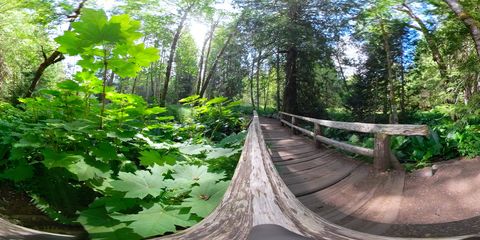
About this place
Investigate Hoh temperate rainforest Sitka spruce nurse-log regeneration, epiphytic bryophytes, and Roosevelt elk.
For kids: Tiptoe into an emerald fairy-tale forest where giant spruce trees stand on stilts grown atop mossy nurse logs!
Olympic Hoh Moss Rainforest · 360° Habitat Camp
What to look for
- Mossy Sitka spruce nurse log — Picea sitchensis nurse-log colonnade. Centre a decaying nurse log elevating spruce seedlings above floor moss
- Draped clubmoss & maple canopy — Selaginella oregana & canopy soil roots. Scan bigleaf maple limbs supporting epiphytic bryophytes and canopy roots
- Roosevelt elk fern clearing — Cervus canadensis roosevelti herbivory. Locate the sword-fern understory corridor maintained by non-migratory elk
Source: Harmon & Franklin (1989), Ecology; Nadkarni (1984), Science — Nurse-log competition escape & adventitious canopy roots in Olympic rainforests.
Ask together: Why do five giant spruce trees sometimes stand in a perfectly straight line on wooden 'stilts' with air underneath?
Field quiz
Kids' question: Why are fallen giant tree trunks in the Hoh Rain Forest called 'nurse logs'?
- Spongy damp wood feeds and cradles rows of baby seedlings above thick floor moss
- Bears wear bandages there
- Logs float downstream to the ocean
Answer
Spongy damp wood feeds and cradles rows of baby seedlings above thick floor moss
Adults' question: How do Hoh bigleaf maples tap nutrients stored inside their own heavy epiphytic moss canopies?
- Sprouting adventitious canopy roots directly from upper bark into epiphytic organic mats
- Dropping all branches every winter to crush mosses
- Pumping salt water upward from Pacific tides
- Digesting insects with sticky carnivorous leaves
Answer
Sprouting adventitious canopy roots directly from upper bark into epiphytic organic mats
360° photo: Mount Rainier NPS, CC BY 2.0
See it live: Live check: Pacific Northwest Marine Mist Cam
- By day
- Northern fur seals, sea otters grooming in mist, & coastal seabirds Onshore North Pacific moisture condenses against the Olympic Mountains, delivering the 3,500 mm rainfall sustaining Hoh's bryophytes.
- By night
- Resting marine mammals & misty North Pacific swell Maritime thermal buffering keeps Olympic coastal rainforests mild year-round, enabling winter bryophyte photosynthesis.
Other language: Русский