Madagascar Giant Baobab Ark
Menabe Avenue of the Baobabs, Morondava, Madagascar · Africa · savanna
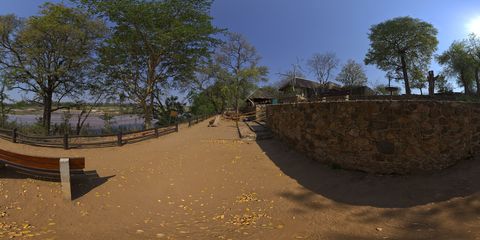
About this place
Examine Adansonia grandidieri parenchymatous water storage, sphingid/lemur nocturnal pollination, and island endemism.
For kids: Stand beneath towering upside-down-looking baobab trees that store rainwater like barrels and bloom at dusk for lemurs!
Madagascar Giant Baobab Ark · 360° Habitat Camp
What to look for
- Cylindrical water-barrel trunk — Adansonia grandidieri parenchyma capacitance. Centre the massive pachycaul trunk storing monsoon water in low-density parenchyma
- Upside-down root-like crown — Sphingophilic & lemur nocturnal blossoms. Scan the flat-topped crown bearing nocturnal blossoms pollinated by hawk-moths and lemurs
- Seasonal mirror pool & red track — Gondwanan island ark endemism (~90%). Locate the seasonal Menabe wetland remnant beside the historic dry-forest corridor
Source: Baum (1995), Annals of the Missouri Botanical Garden & Chapotin et al. (2006), Plant, Cell & Environment — Baobab pollination syndromes & stem water capacitance.
Ask together: Why do evening-blooming flowers smell extra sweet and shine pale white instead of bright daytime red?
Field quiz
Kids' question: Out of all eight species of baobab trees on Planet Earth, how many are native ONLY to the island of Madagascar?
- Six out of eight live nowhere else in the wild!
- Zero—baobabs only grow in snowy Antarctica
- Only tiny bonsai baobabs in flowerpots
Answer
Six out of eight live nowhere else in the wild!
Adults' question: What primary physiological role does stored water inside Adansonia grandidieri parenchymatous wood serve (Chapotin et al., 2006)?
- Maintaining mechanical stem turgor and enabling pre-rain leaf flushing before monsoon onset
- Circulating boiling geothermal steam to melt winter frost
- Excreting saltwater brine onto surrounding competitors
- Digesting trapped insects inside hollow pitcher branches
Answer
Maintaining mechanical stem turgor and enabling pre-rain leaf flushing before monsoon onset
360° photo: Greg Zaal, CC0
See it live: Live check: East African Dry-Forest & Baobab Belt Cam
- By day
- Lesser kudu, Maasai giraffes, elephants, impalas & hornbills Across the 400 km Mozambique Channel, mainland Africa's single baobab (Adansonia digitata) coexists with ungulates absent from Madagascar.
- By night
- Nocturnal hawk-moths, genet cats, bushpigs & African baobab pollinators Darwin famously predicted Madagascar's 30 cm-proboscis hawk-moth (Xanthopan praedicta) decades before its discovery from deep-spurred night flowers.
Other language: Русский