Komodo Savanna & Iron-Toothed Dragons
Loh Liang Bay, Komodo National Park, Lesser Sunda Islands, Indonesia · Asia · savanna
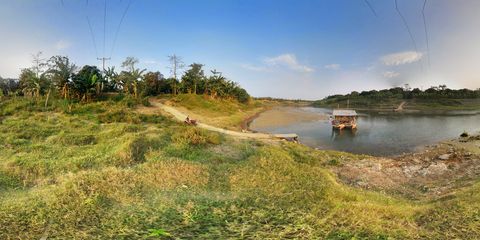
About this place
Examine Varanus komodoensis stereo vomeronasal chemotaxis, chain-mail osteoderms, and iron-enriched serrated enamel.
For kids: Explore dry palm-dotted islands where Earth's biggest lizards smell the breeze in stereo with forked tongues and grow orange iron-coated teeth!
Komodo Savanna & Iron-Toothed Dragons · 360° Habitat Camp
What to look for
- Monsoon-shadow lontar savanna ridge — Stereo vomeronasal scent plume. Locate the dry lontar-palm ridge funneling trade-wind odor plumes
- Sun-warmed volcanic trail & burrows — Osteoderm armor & iron-capped ziphodonty. Centre the sunlit lowland flat where adult monitors thermoregulate
- Tamarind canopy & tidal beach — Ontogenetic arboreal niche shift. Scan the coastal tamarind crowns sheltering arboreal juvenile monitors
Source: LeBlanc et al. (2024), Nature Ecology & Evolution — Iron-coated serrated tooth enamel in Varanus komodoensis; Auffenberg (1981) — Stereo vomeronasal tracking.
Ask together: Why does having two separate tips on a forked tongue help a Komodo dragon tell whether a smell is coming from the left or the right?
Field quiz
Kids' question: What metal did scientists recently discover coating the sharp edges of a Komodo dragon's teeth?
- Orange-tinted iron that keeps their tooth edges strong and sharp
- Shiny liquid mercury
- Soft yellow gold from pirate treasure
Answer
Orange-tinted iron that keeps their tooth edges strong and sharp
Adults' question: What structural function does the orange pigment along Varanus komodoensis tooth serrations serve (LeBlanc et al., 2024)?
- Concentrated iron-oxide coating reinforcing ultra-thin ziphodont enamel against wear
- Copper-based bioluminescent lure attracting nocturnal bats
- Calcium-free chitin shed after every single meal
- Magnetic compass crystals aligning jaws north-south
Answer
Concentrated iron-oxide coating reinforcing ultra-thin ziphodont enamel against wear
360° photo: Aris riyanto, CC BY-SA 4.0
See it live: Live check: Island Megafaunal Reptile Basking Cam
- By day
- Giant island tortoises basking on sun-warmed turf, extending necks & grazing greens Large-bodied island reptiles—both giant tortoises and Komodo monitors—exhibit gigantothermy, using low surface-to-volume ratios to buffer temperature swings.
- By night
- Quiet coastal reptile paddock as ectotherms conserve daytime thermal inertia High thermal inertia slows nocturnal cooling rates compared with small lizards, extending digestive enzyme efficiency overnight.
Other language: Русский