Iguazú Cataracts & Waterfall Swifts
Iguazú Falls, Upper Paraná Atlantic Forest, Argentina · Latin America & Reefs · rainforest
About this place
Examine Cypseloides senex cataract-penetration nesting ecology, Serra Geral flood-basalt steps, and spray-zone Atlantic Forest refugia.
For kids: Stand in rainbow waterfall spray where fearless dusky swifts fold their wings and dive straight THROUGH roaring curtains of water!
Iguazú Cataracts & Waterfall Swifts · 360° Habitat Camp
What to look for
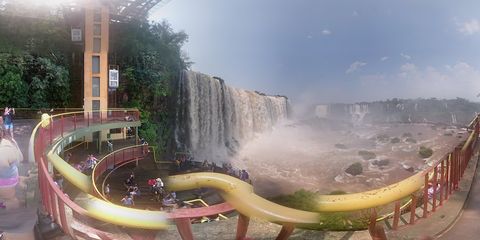
- Roaring waterfall swift doorway — Cypseloides senex hydro-barrier entry. Centre the sheer cataract sheet penetrated by commuting Cypseloides senex
- Spray-shielded basalt cliff ledges — Serra Geral basalt & mucronate tail prop. Locate the wet flood-basalt steps where swifts cling via needle claws and tail spines
- Rainbow mist & aerial insect plume — Cataract updraft & Podostemaceae riverbeds. Scan the turbulent spray plume lifting aquatic insects into swift foraging lanes
Source: Marín (2000) & Macchi et al. (2021), Ornithology Research — Cypseloides senex cataract-penetration flight and vertical wet-cliff nesting.
Ask together: Why is building your nest right behind a roaring waterfall the cleverest castle moat in the whole rainforest?
Field quiz
Kids' question: Why do great dusky swifts dive straight through Iguazú's roaring waterfalls every morning and evening?
- To reach secret moss nests tucked safely on rock ledges behind the falling water!
- To catch jumping salmon in their beaks
- To wash mud off their winter boots
Answer
To reach secret moss nests tucked safely on rock ledges behind the falling water!
Adults' question: Which anatomical pair allows Cypseloides senex to roost vertically for hours on slick, spray-soaked basalt walls behind waterfalls?
- Needle-sharp curved claws paired with stiffened, spine-tipped tail feathers acting as a vertical brace
- Suction-cup toe pads identical to glass tree frogs
- Webbed diving paddles and solid marrowless leg bones
- Prehensile hooked bills clamped into basalt cracks
Answer
Needle-sharp curved claws paired with stiffened, spine-tipped tail feathers acting as a vertical brace
360° photo: Ricardo de Sampaio Dagnino, CC BY-SA 4.0
See it live: Live check: Neotropical Stream & Mist Bird Cam
- By day
- Rufous-tailed hummingbirds, violet-headed hummingbirds & stream-side tanagers Swifts (Apodidae) and hummingbirds (Trochilidae) are sister clades inside Apodiformes—sharing shortened humeri and extreme hand-wing dominance.
- By night
- Rushing mountain stream white-noise & nocturnal cloud-forest insects Compare Iguazú's subtropical latitude (25.7°S) in your telemetry panel with equatorial Neotropical stream conditions.
Other language: Русский