Iceland Arctic Fox Sea Cliffs
Hornstrandir Nature Reserve, Iceland · Arctic & Subarctic · wetland_coast
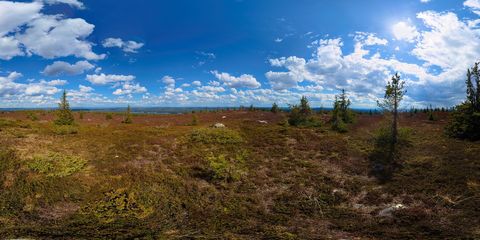
About this place
Examine Vulpes lagopus coastal 'blue' colour-morph genetics, countercurrent paw heat exchange, and seabird cliff ecology.
For kids: Explore towering green sea cliffs where Iceland's native blue-brown Arctic foxes tiptoe below puffin burrows!
Iceland Arctic Fox Sea Cliffs · 360° Habitat Camp
What to look for
- Turf-capped puffin cliff ledge — Fratercula arctica burrow terrace. Locate the vegetated basalt terrace honeycombed with alcid burrows
- Dark basalt intertidal boulders — Coastal 'blue' Vulpes lagopus foraging zone. Centre the ice-free intertidal boulder zone matching the coastal blue fox morph
- Denmark Strait gale horizon — Countercurrent rete mirabile paws. Survey the Denmark Strait marine horizon driving subarctic storms
Source: Våge et al. (2005), Genetics & Hersteinsson & Macdonald (1996) — MC1R mutation & adaptive habitat matching in coastal vs. tundra Arctic foxes.
Ask together: Why is a dark charcoal coat better camouflage on an ocean beach than a bright snow-white coat?
Field quiz
Kids' question: How did Iceland's very first wild Arctic foxes reach this island long ago?
- They trotted across frozen sea ice at the end of the Ice Age!
- Vikings flew them over on kites
- They swam underwater like seals
Answer
They trotted across frozen sea ice at the end of the Ice Age!
Adults' question: Why don't Arctic fox footpads freeze or melt snow into ice balls at −40 °C?
- Countercurrent arteriovenous heat exchange plus polyunsaturated paw-pad lipids
- Thick keratin hooves covering every toe
- Heated sweat glands pumping boiling blood
- Walking exclusively on hind legs
Answer
Countercurrent arteriovenous heat exchange plus polyunsaturated paw-pad lipids
360° photo: Jojoo64, CC BY-SA 4.0
See it live: Live check: North Atlantic Puffin Burrow Cam
- By day
- Atlantic puffins carrying shiny sand eels, razorbills, & Manx shearwater burrows Backward-pointing keratinous spines on the tongue and palate let Fratercula arctica hold 10–60 sand eels while diving for more.
- By night
- Nocturnal Manx shearwaters returning to cliff burrows by scent & starlight Hundred-thousand-strong Manx shearwater colonies commute ashore strictly in darkness to evade diurnal great black-backed gull predation.
Other language: Русский