Alaska Permafrost Muskoxen
Tanana Valley, Fairbanks, Alaska · Arctic & Subarctic · polar
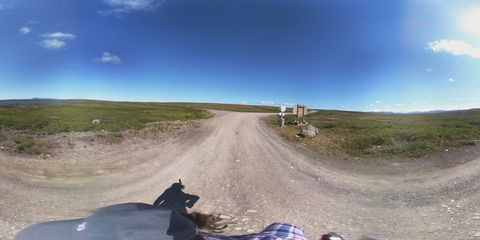
About this place
Investigate Ovibos moschatus qiviut thermal physics, cranial boss impact absorption, and defensive phalanx ethology.
For kids: Stand beside woolly Ice-Age giants that form a superhero circle of horns around their calves!
Alaska Permafrost Muskoxen · 360° Habitat Camp
What to look for
- Wind-scoured sedge clearing — Permafrost active-layer forage. Locate the wind-thinned snow pasture where herds crater for cured sedges
- Drunken-forest permafrost spruces — Picea mariana permafrost root mat. Centre the black spruce treeline rooted above shallow permafrost
- Phalanx lookout knoll — Cooperative anti-predator ring. Scan the elevated vantage point suited for 360° wolf detection
Source: Ackermans et al. (2022), Acta Biomaterialia — Trabecular bone shock absorption in Ovibos moschatus headbutting.
Ask together: Why is standing together in a circle facing outward much safer for muskox calves than running away in deep snow?
Field quiz
Kids' question: What happens in spring when muskoxen shed their super-warm inner wool called qiviut?
- Songbirds gather tufts off bushes to line warm nests!
- It melts into water
- It turns bright green
Answer
Songbirds gather tufts off bushes to line warm nests!
Adults' question: Which anatomical feature protects bull muskox brains during 50 km/h head-on rutting collisions?
- 10-cm keratinous horn bosses backed by spongy energy-absorbing sinus bone
- Fluid-filled inflatable cheek pouches
- Detachable antlers shed before impact
- Cartilaginous flexible skulls like sharks
Answer
10-cm keratinous horn bosses backed by spongy energy-absorbing sinus bone
360° photo: toolik, CC BY-SA 4.0
See it live: Live check: Fairbanks Muskoxen Pasture Cam
- By day
- Grazing & sparring muskoxen, ravens, & summer calves playing on logs University of Alaska Fairbanks ethologists study muskox nutrition, qiviut combing, and seasonal hormone rhythms here.
- By night
- Ruminating muskoxen under midnight twilight or winter aurora skies At 64.8°N just south of the Arctic Circle, Fairbanks swings from 21h 49m summer daylight to 3h 41m winter twilight.
Other language: Русский