Pink in the Salt · Laguna Chaxa 360°
Laguna Chaxa, Salar de Atacama, Chile · Latin America & Reefs · desert_night
About this place
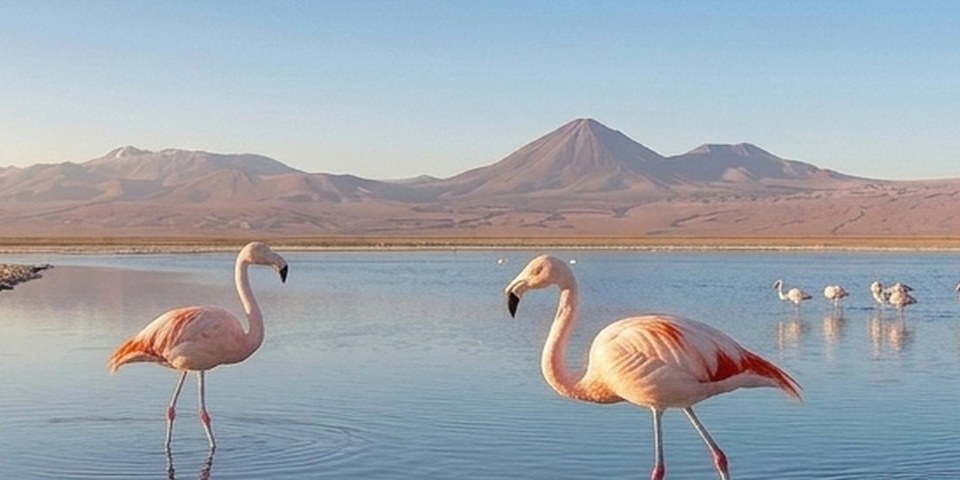
5-minute generated 360° reconstruction of Laguna Chaxa, Salar de Atacama—observing Chilean flamingo inverted filter-feeding, carotenoid pigmentation, and desert brine ecology.
For kids: Watch our 5-minute generated 360° wildlife film at Laguna Chaxa! How can a salt lagoon that looks almost empty feed so many Chilean flamingos?
Pink in the Salt · 05:00 360° Film
A 5-minute generated 360° reconstruction of Laguna Chaxa, Salar de Atacama (stereo mix, EN/RU narration & synchronized captions). Observe shoreline-to-shallows continuity, optional view guidance that yields immediately on drag, and post-film route choices.
Source: Phoenicopterus chilensis filter-feeding & carotenoid metabolism at Sector Laguna Chaxa, Reserva Nacional Los Flamencos (~2,300 m, CONAF Chile); Mascitti & Kravetz (2002), Waterbirds; Chang & Ting (2017), Biology Letters.
Ask together: How can a place made of crusty salt and shallow water—that looks almost empty at first glance—hide a feast for a whole flock of flamingos?
Field quiz
Kids' question: How does the flamingo collect its tiny food?
- It filters food from the water with its bill.
- It catches fish with its feet.
- It gets food from the salt crystals on its feathers.
Answer
It filters food from the water with its bill.
Adults' question: How does the flamingo collect its tiny food?
- It filters food from the water with its bill.
- It catches fish with its feet.
- It gets food from the salt crystals on its feathers.
- It dives deep underwater to chase schools of fish.
Answer
It filters food from the water with its bill.
See it live: Live check: High-Andean Mountain Wildlife Watch
- By day
- High-altitude giant & sword-billed hummingbirds and Andean mountain tanagers Compare Salar de Atacama's 2,300 m hyper-arid telemetry with live high-Andean bird physiology along the same cordillera.
- By night
- Crisp thin-air Andean night & rapid radiative desert-mountain cooling Near-zero precipitable water vapour over Salar de Atacama drives 25 °C diurnal-nocturnal temperature swings across shallow brine pans.
Other language: Русский